
Custom Home Theater & Media Room Cost in Austin & Houston: 2026 Pricing by Room Size, Dolby Atmos & Acoustics
TL;DR — 2026 Texas Home Theater Pricing Summary: As typical Texas installed ranges (always quoted per project), a well-designed media room with a large 4K display or projector, a 5.1.2 or 7.1.2 Dolby Atmos speaker system, and lighting control usually runs $22,000 to $48,000. A dedicated Dolby Atmos cinema with a native 4K laser projector, acoustically transparent screen, 7.1.4 or larger speaker layout, acoustic treatment, and theater seating typically ranges from $50,000 to $115,000. Reference-level private cinemas with 9.1.6 or larger layouts, multiple subwoofers, room-tuned calibration, and full room construction commonly start around $120,000 and can exceed $250,000.
A home theater is one of the few rooms in a house where the design decisions are almost entirely invisible—the speaker positions behind the screen, the acoustic panels under the fabric, the cooling for the equipment rack—yet those decisions determine whether the room feels like a commercial cinema or just a big TV in a dark room. Homeowners planning theaters in Westlake, Lakeway, Cedar Park, Leander, and Lago Vista, or in Cypress, Katy, Sugar Land, The Woodlands, and Conroe, should understand where the budget actually goes.
At Capitol Technology Group, we design and install custom theaters and media rooms from our Austin office at 9705 Burnet Rd #319 and our Houston-area office in Cypress. This guide breaks down typical installed costs by tier, explains Dolby Atmos speaker layouts in plain English, and covers the planning steps that matter most in new construction. For local project details, see our Austin home theater and Houston home theater pages.
Media Room vs. Dedicated Theater: Which One Are You Building?
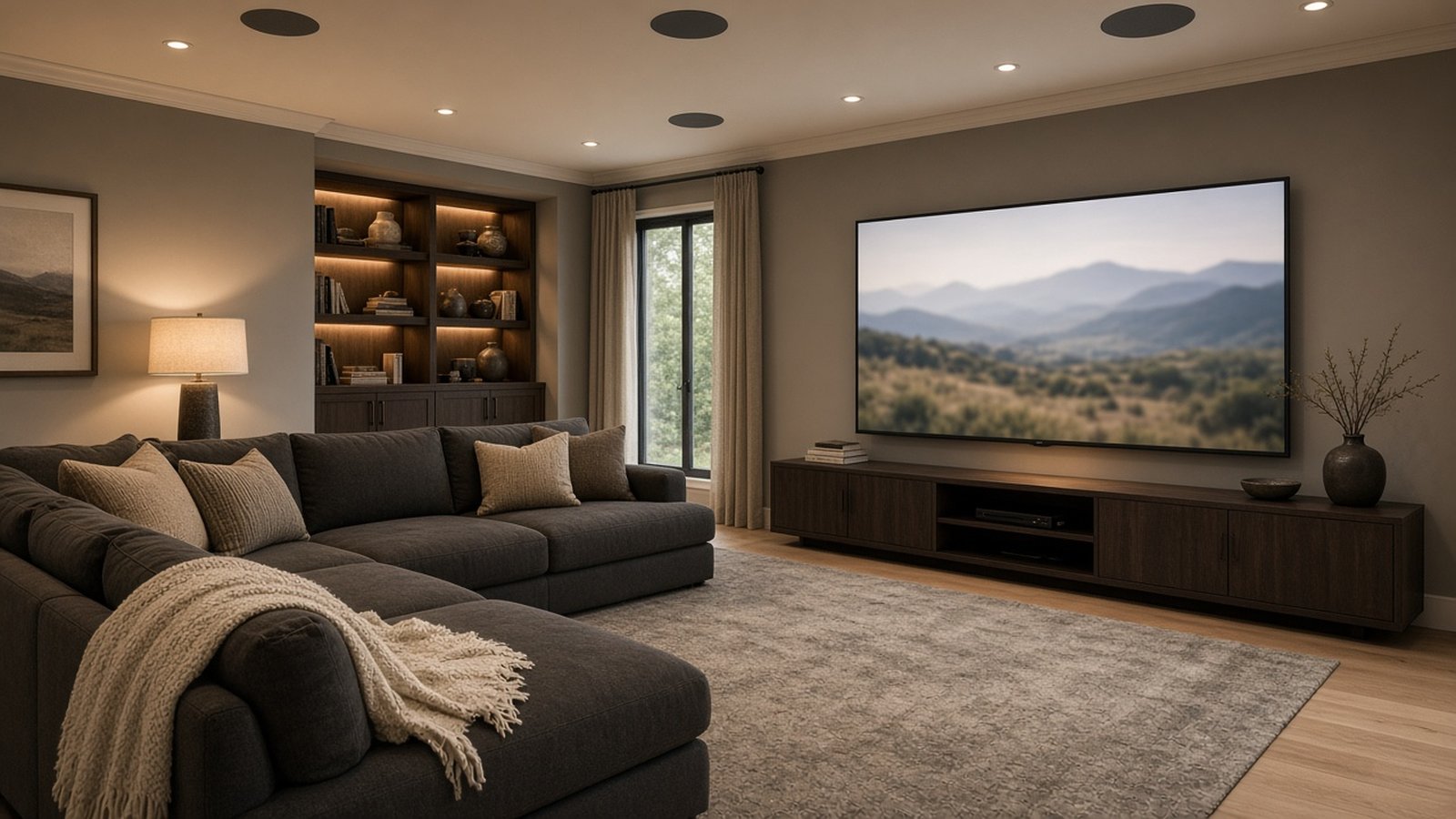
A media room is a multi-purpose space—often a game room or upstairs lounge—that has to work with the lights on, open doorways, and casual seating. A dedicated theater is a closed room designed around one job: controlled light, controlled sound, and optimal sight lines. The distinction drives nearly every cost decision below, from display choice to how much acoustic treatment is worthwhile.
2026 Home Theater Cost in Austin & Houston by Tier
Table 1: Home Theater & Media Room Tiers (Typical 2026 Texas Installed Ranges)
| Tier | Typical Display | Typical Audio Layout | Room Treatment & Control | Typical Texas Installed Range (Quoted Per Project) |
|---|---|---|---|---|
| Media Room | Large-format 4K TV or short-throw/standard projector | 5.1.2 or 7.1.2 Dolby Atmos with in-wall/in-ceiling speakers | Lighting scenes, shades, one-touch control (e.g., Control4) | $22,000 – $48,000 |
| Dedicated Dolby Atmos Cinema | Native 4K laser projector with acoustically transparent screen | 7.1.4 Dolby Atmos (or larger), dedicated subwoofers | Acoustic absorption panels, theater seating, lighting control, rack cooling | $50,000 – $115,000 |
| Reference Private Cinema | High-brightness native 4K laser projector, large or scope-format screen | 9.1.6 or larger, multiple subwoofers, professional calibration | Full room construction (isolation, treatment, riser), custom interiors | $120,000 – $250,000+ |
Ranges are budgeting guidance for Austin and Houston projects, not quotes. Every theater is priced after a site visit or plan review.
Dolby Atmos Speaker Layouts Explained
Dolby names speaker layouts with three numbers. In 7.1.4, the first number is the count of ear-level speakers (left, center, right, surrounds, and rear surrounds), the second is the number of subwoofers, and the third is the number of overhead (height) speakers. Dolby's installation guidelines recommend overhead speakers at roughly 45 degrees of elevation from the listening position (adjustable between 30 and 55 degrees) and centered over the seating area, and recommend four overhead speakers whenever possible for more precise placement of overhead sound. A 9.1.6 layout adds left and right "wide" speakers and a third pair of overhead speakers.
Table 2: Common Dolby Atmos Layouts and Where They Fit
| Layout | Speakers | Overhead Speakers | Best Fit |
|---|---|---|---|
| 5.1.2 | 5 ear-level + 1 subwoofer | 2 | Smaller media rooms and game rooms |
| 7.1.4 | 7 ear-level + 1 subwoofer | 4 (top front + top rear pairs) | Most dedicated theaters; the layout Dolby documents as a reference |
| 9.1.6 | 9 ear-level (adds wides) + 1 subwoofer | 6 (front, middle, rear pairs) | Larger rooms with two or more seating rows |
| Larger configurations | Additional surrounds and multiple subwoofers | 6+ | Reference cinemas with room for more speakers and a processor that supports them |
Choosing a Projector or Display
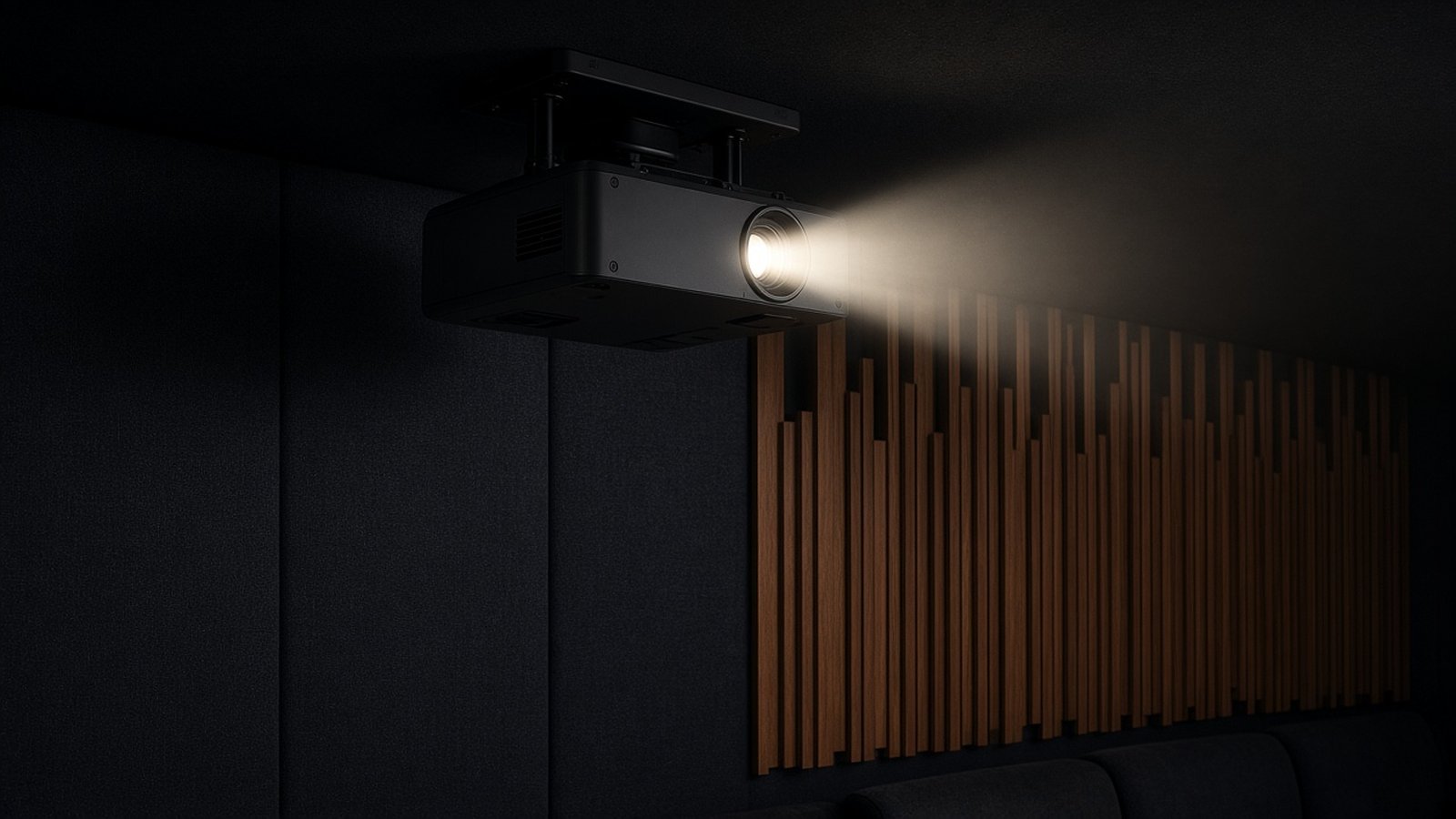
In a dedicated theater, a native 4K laser projector paired with an acoustically transparent screen lets the front speakers sit behind the image, the way commercial cinemas do it. As one example of current models, Sony rates the native 4K VPL-XW5000ES at 2,000 lumens and the VPL-XW7000ES at 3,200 lumens with a motorized 2.1x lens. Brightness, screen size, screen material, and how much light the room lets in all have to be designed together. In media rooms that are used during the day, a large-format TV is often the better choice.
Acoustics: The Line Item That Separates Good Rooms From Great Ones
- Absorption and diffusion panels, often hidden behind stretched fabric, control echo so dialogue stays clear.
- Sound isolation—decoupled walls, solid-core doors, and sealed penetrations—keeps theater sound from carrying into bedrooms, and is far easier to build in during framing than to add later.
- Subwoofer placement and calibration smooth out bass across seats; using more than one subwoofer generally gives more even bass in larger rooms.
- Room calibration with measurement microphones and the processor's room-correction tools is the final step.
Planning a Theater in a New Texas Custom Home
For new construction in the Cedar Park, Leander & Lago Vista area, Katy & Sugar Land, or Conroe, Magnolia & Montgomery, we recommend bringing your integrator in at the blueprint stage:
Table 3: 4-Phase New-Build Theater Timeline
| Phase | When | What Happens |
|---|---|---|
| 1. Design | Blueprint review, before framing | Room dimensions, seating and riser layout, screen size, speaker locations, equipment location |
| 2. Rough-in | After framing, before insulation | Speaker, projector, and control wiring; conduit to the equipment rack; electrical and HVAC coordination; isolation details |
| 3. Trim-out | After drywall and paint | Speakers, screen, projector, acoustic treatment, seating, lighting |
| 4. Calibration & handoff | Before move-in | Audio and video calibration, control programming, homeowner walkthrough |
Keeping Equipment Cool in Texas Homes
Texas summers make equipment cooling a real design question. We recommend locating the AV rack in conditioned space rather than in an attic or unconditioned garage, providing dedicated ventilation or cooling for the rack, and coordinating with your HVAC contractor so the theater has its own return and stays comfortable with the door closed and a full room of guests.
Converting an Existing Room Into a Theater
Many Austin and Houston homeowners convert an existing game room, bonus room, or spare bedroom. Retrofits can use in-wall speakers fished through existing walls, wireless lighting control, and battery-powered motorized shades, with acoustic treatment added as wall panels. Full sound isolation is harder to retrofit, so we assess the room first and set expectations accordingly.
See a System in Person or Book a Design Consultation
Reach our Austin office at 9705 Burnet Rd #319 or call (512) 883-6436. In Greater Houston, visit our Cypress office and Lighting Lab at 16012 Kitzman Rd, (281) 393-4850. Start with our Austin home theater or Houston home theater pages.
Frequently Asked Questions: Home Theater Cost in Austin & Houston
1. How much does a custom home theater cost in Austin or Houston?
As typical Texas installed ranges quoted per project, a media room usually runs $22,000 to $48,000, a dedicated Dolby Atmos theater $50,000 to $115,000, and a reference-level private cinema from about $120,000 to $250,000 or more.
2. What does 7.1.4 mean in a Dolby Atmos theater?
7.1.4 means seven ear-level speakers, one subwoofer, and four overhead speakers. Dolby recommends the overhead speakers at roughly 45 degrees of elevation from the seating position, centered over the listening area.
3. Should I choose a projector or a large TV?
For a dedicated, light-controlled theater, a native 4K laser projector with an acoustically transparent screen delivers the most cinema-like experience. For media rooms used during the day with windows and open doorways, a large-format TV is often the better choice.
4. When should I involve a theater designer in a new custom home?
We recommend involving your integrator at blueprint review, before framing. That is when room dimensions, riser layout, speaker locations, isolation, and equipment cooling can be planned without costly changes later.
5. Can I turn an existing room into a home theater?
Yes. Game rooms, bonus rooms, and spare bedrooms are common conversions using in-wall speakers, wireless lighting control, battery-powered shades, and acoustic panels. Full sound isolation is harder to add after construction, so we evaluate the room first.
6. Where should the AV equipment rack go in a Texas home?
We recommend conditioned space with dedicated ventilation or cooling, not an attic or unconditioned garage, because summer heat shortens equipment life and can cause shutdowns.
